If your child has spent a season or two on indoor snow and you are now weighing up a first ski camp in the Alps, you may have noticed something odd. They can hold an edge beautifully. Ask them to ski a whole mountain, though, and the picture shifts. Indoor snow builds genuine skill, but it rarely tests terrain range.
That is the heart of the choice between a race academy week and a freestyle week. One hands your child a measurable reference point: gates, timed runs, video feedback. The other rewards expression in the park, and it only pays off for children who can already ski a full day without tiring out.
Below, we look at what indoor snow builds and what it leaves untested, what each week actually involves, who suits which programme, and the fatigue question that decides more than most parents expect. We will also cover how formal race pathways fit beyond a single camp week, plus practicalities for a first alpine camp. Comparing ski camps in Switzerland? Start with the reference point, then choose the discipline. Explore our programmes to find the right fit for your family.
What Indoor Snow Builds, and What It Leaves Untested
Indoor snow is a controlled surface: same temperature, same groomed texture on every run, no wind, no flat light, no surprise bumps. That consistency is exactly why children make fast progress on their edges there.
After a season or two indoors, most can hold an edge, stop reliably and link turns on a gentle slope. What they have rarely met is terrain that changes underfoot from one run to the next.
A real alpine slope adds what a fridge cannot: soft powder, heavy wet snow, ice patches, narrow traverses, moguls, and runs measured in kilometres rather than metres. Reading that is a different skill from turning well.
Treat this as the working observation of experienced instructors, not a research finding. In our reading, no published study tests how indoor training transfers to outdoor alpine terrain, so it is honest to call it judgement rather than rule.
The takeaway for a first alpine week: the goal is range and confidence on real snow, not how polished your child already looks. Explore winter ski camp options with that in mind.
Inside a Race Academy Week: Gates, Timed Runs and Video
A race academy week is built on repetition. Gates are set on a prepared slope, a coach stands at the side, and your child skis the same line again and again, taking one small correction into each run.
Days usually alternate free skiing for warm-up and technique, then gate training, then a debrief. Video review is common, so a child sees their own stance and body position rather than only hearing about it.
A gate is a pole pair a skier passes between; the course is the sequence of gates; a timed run is one measured attempt, recorded in tenths or hundredths of a second. That number belongs to your child. Going from 32 seconds to 30 seconds is progress nobody can argue with, and many families treat it as the reference point for a week of focused race training.
Whether that suits your child depends on temperament.
Who a Race Academy Week Suits, and Who Should Wait a Season
If that balance of repetition and feedback sounds appealing, here is the honest test. A race week suits the child who likes doing a thing again until it feels right, and who is not upset by a slower time than someone else’s. It also suits a child who can be filmed and watched by a small group without shrinking; many find video review motivating, while others find it exposing.
Families who want something portable get it too: a time, a video and a coach’s notes you can hand to next season’s instructor in Switzerland or anywhere else.
Wait a season if your child tires before lunch, dislikes standing around in the cold, or has never skied a full day. Gate training means queueing for the course, and that is a lot of standing still.
This is where Confidence and Competence sit most naturally. A child measures their own progress, then learns to trust a technique they have practised until it holds. It is worth seeing how that carries into confidence and leadership skills.
Inside a Freestyle Week: All-Mountain Skiing and the Park
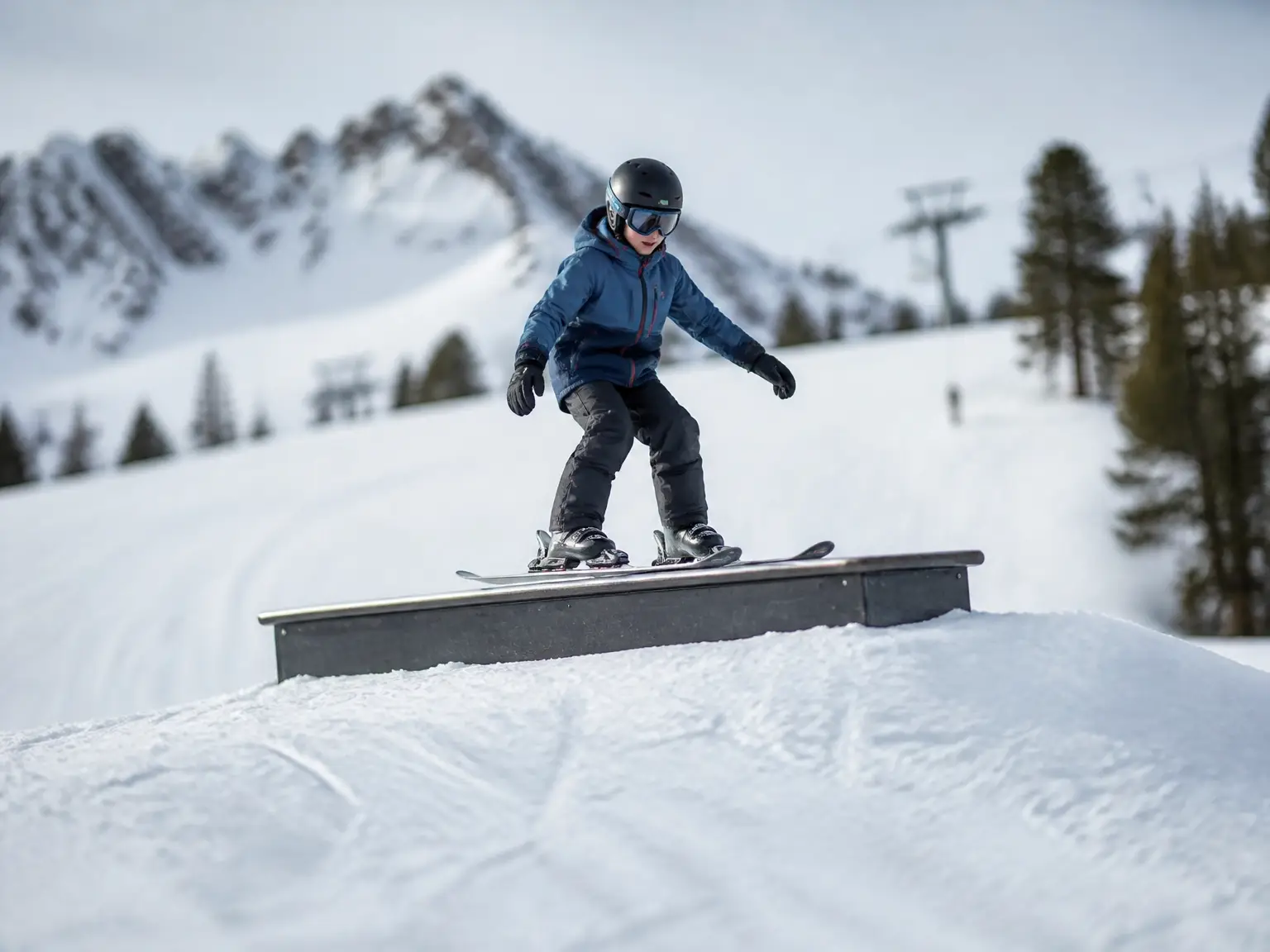
A freestyle week, by contrast, runs on different energy. Days usually split between all-mountain skiing and a terrain park, where children meet small jumps, boxes and rollers sized to their age and experience.
Worth defining first: rollers are gentle undulations in the snow; boxes are low, wide structures skied along, not jumped onto; a park is a dedicated area whose features the resort builds and maintains.
Coaches build up cautiously: straight runs over a roller, then small airs with a flat landing, then more size. Progression is individual, and not every child reaches the same feature in the same week.
Ski cross and boarder cross sit elsewhere. Snowsport Cymru Wales describes them as on-snow only disciplines with banked turns, rollers and jumps, so indoor snow cannot prepare a child for them.
Still weighing gates against park? What racing teaches young skiers is worth a read.
Who a Freestyle Week Suits, and Who Should Wait a Season
A freestyle week rewards a child who already skis a full day without tiring and finds repetition dull. Working park features asks for energy and attention at once, run after run.
It also suits the child who wants variety and is happy to try something in front of peers, imperfectly, possibly first. That appetite matters more than natural talent.
Tolerance for falling counts too. A new feature usually means failing once or twice, and children upset by a tumble often enjoy gates or all-mountain skiing more at this stage. Read how racing builds young confidence and the contrast becomes clear.
Wait a season if the fundamentals are still forming. Park skiing sits on solid edge control, balance and the confidence to hold a line on a surface that changes underfoot.
Courage and Connection carry this week. Trying something new beside friends, and cheering each other through it, is often what children remember long after the snow has gone.
Race Academy or Freestyle Week: The Factors That Really Decide It
With both weeks described, the deciding factors are less about skiing than about your child.
Fatigue tolerance comes first. A race week is short runs and long waits in the cold; a freestyle week keeps a child moving. Which one drains your child faster depends on them, not the discipline.
Then appetite. Race training asks a child to ski the same line repeatedly and enjoy the tiny differences. Freestyle training asks them to move on to the next feature, then the next.
Measurement follows. Racing gives a child a number, sometimes beside peers on the same course. Freestyle gives no score, only whether the movement worked and whether it felt good.
Video separates them too. It is central to race coaching and how technique improves. In the park, filming is usually optional and mostly for fun.
What travels home differs. A race week leaves a time, a video and a coach’s notes. A freestyle week leaves a broader comfort zone and, for many children, a new group of friends.
Group dynamics matter. A race group moves and waits together; a park group spreads out across a feature. Think honestly about which your child handles better.
Don’t compare headline prices alone. Published comparison data on youth camp formats is scarce, and costs, hours on snow and group sizes vary widely. Ask about hours on snow, coach-to-child ratio and maximum group size.
One safety note for both: governing bodies publish athlete safety and concussion guidance for youth programmes. Ask any provider how they apply that framework, and remember that no snowsport activity is risk-free.
Stamina runs through every one of these.
The Fatigue Question: Can Your Child Ski a Full Day Yet?
Here is the test that matters more than talent. Can your child ski from morning to late afternoon and still want to ski again the next morning? It is a heuristic, not a measurement, but a good one.
Fatigue rarely announces itself as tired legs. Watch for sloppy technique, tears at the lift and a fading interest in the next run. A tired child also stops absorbing what a coach is telling them, however good the instruction is.
A race week absorbs a tired child more gently than a freestyle week. Gates are stop-start by design, while park sessions ask for sustained energy and decision-making run after run.
Before booking, audit your child’s indoor sessions. How much of the hour is actually spent skiing, and how much is resting, snacking or warming up at the side? Two hours of movement across a three-hour booking means a full alpine day will be a genuine shock, whatever the discipline. Match the programme to the stamina your child has now, not the stamina you hope they will have by February.
Reference Point First, Discipline Second: A Simple Way to Choose
Stamina narrows the field. Now let the reference point make the call.
Start there. Ask what you want your child to be able to see about their own progress by Friday, then work backwards from it.
If the answer is a number, a video and a clear next step for next season, a race academy week hands over exactly that kind of feedback.
If it is a wider comfort zone on real alpine terrain, plus the memory of doing something bold alongside other children, freestyle is the better fit.
Now check that answer against your child, not your family’s ski history. Repetition or variety? Measured or left to play? Filmed or anonymous?
If both still feel plausible, pick the one that matches your child’s stamina today. A child who finishes the week still enjoying the mountain will progress faster next season than one who finishes it exhausted.
Would you rather talk it through than work it out alone? AlpinXperiences creates curated alpine experiences in the Swiss Alps for families with children, and can help you think through which format suits your child. Get in touch to find the right experience.
How Formal Race Pathways Fit Beyond the Camp Week
Beyond that first week, race can lead somewhere. National governing bodies publish formal structures for young skiers. The U.S. Ski & Snowboard Alpine Competition Guide sets out an Alpine Development Pyramid, FIS international children’s competitions, and a points and rankings system. Those points compare results across races and seasons, useful if you consider a competitive route later. The guide does not explain how one camp week fits in. Some countries build early development on artificial slopes. Snowsport Cymru Wales describes artificial slopes in Wales used by school children, alongside a published Alpine Skiing Pathway. These pathways show how national bodies structure development over years, not what a first camp week should contain. A first alpine week in the Swiss Alps need not start a competition career. It needs to build range, and leave your child wanting next season. Later, explore elite race academy pathways.
Practicalities for a First Alpine Camp: Age, Pacing and Supervision
Before you book either format, the practical details decide how good the week feels.
Ask how children are grouped. Many programmes sort by ability, not age alone, and smaller groups mean more coaching time per child. Confirm the maximum group size before you pay a deposit.
Pacing matters too. A well-run week assesses the group on day one, then adjusts daily, mixing free skiing with the focus rather than six solid hours of gates or park laps.
Ask who is with the children between sessions, at lunch and on the lifts. Those unglamorous hours matter most for supervision and are rarely mentioned in brochures.
Treat safety as a framework, not a promise. Governing bodies publish athlete safety guidance for youth programmes; ask how a provider applies it. No snowsport activity is risk-free.
Before booking, send these questions: hours on snow per day, coach-to-child ratio, maximum group size, the plan for poor weather or a closed lift, whether equipment and a helmet are included, and what the week ends with. For more, read our family ski camp guidance.
How to Decide This Winter
Start with the reference point, then pick the discipline. That order alone takes most of the worry out of booking a first alpine winter camp.
If your child lights up at a number, a video and a clear step forward, weigh a race academy week. The feedback is immediate, honest and easy to carry into next season.
If they ski a full day without tiring, and thrive on variety and trying things beside friends, weigh a freestyle week instead.
If neither feels clear yet, book a week that builds range on real alpine terrain and decide at the end. Terrain range is the gap indoor snow leaves, and every child needs it before specialising.
Wondering what a week abroad really gives a child? Read what a Swiss Alps camp offers.
Get in touch to find the right experience for your family, and explore ski camps in Switzerland with someone who knows how these weeks actually run.
Conclusion
Choosing between a race academy week and a freestyle week starts with your child, not the label. Ask whether they can ski a full day, how they respond to numbers, video and clear feedback, and whether they thrive on variety and friends. A race academy suits children who enjoy gates, timed runs and a visible step forward. A freestyle week suits those with stamina for all-mountain skiing and park time. If neither feels clear, choose a week that builds range on real alpine terrain before specialising. Keep safety as a framework, ask providers the practical questions, and let confidence, courage, connection and competence grow at your child’s own pace. When you are ready, get in touch with AlpinXperiences to find the right ski camp in Switzerland for your family.